Difference Between The Detailed Estimating VS Free Estimating?
A straight-talk guide for NYC homeowners and property managers who are done getting burned
By a 20+ Year NYC General Contractor — Updated Q2 2026
You’ve got a gut renovation in Brooklyn, a bathroom remodel in a Murray Hill co-op, or a commercial buildout in Long Island City. You call three contractors. Two of them come back within 24 hours with a free estimate. The third tells you they charge $1,200 for a pre-construction consultation. You think the first two are doing you a favor.
They are not.
That free estimate? It’s a sales tool. It’s designed to get you to sign a contract — not to accurately represent what your project will cost. This guide explains the difference between what you’re being handed and what you actually need to protect yourself in one of the most expensive construction markets in the world.
What Is a Free Estimate? Must You Need to Know
Let’s be direct: a free estimate is a lead-generation tool. It’s a marketing document masquerading as a budget figure. A contractor who visits your apartment for 30 minutes, eyeballs your kitchen, and hands you a number — or emails you one the next morning — has not done a takeoff. They’ve done a gut-check. And in a market like New York City, gut-checks don’t survive first contact with reality.
The typical free estimate in the NYC metro market in 2026 will include:
- A single total dollar figure, sometimes with a rough breakdown into “labor” and “materials”
- Little to no mention of NYC Department of Buildings (DOB) permit filings or associated fees
- No reference to Certificate of Insurance (COI) requirements from your building’s management
- Vague material allowances (“cabinets up to $5,000”) rather than specified products and vendors
- No contingency line. None.
That last point alone should terrify you. In a market where a licensed master electrician in Manhattan bills out at $175–$225/hour and structural steel delivery from the Bronx to South Brooklyn can carry surcharges that weren’t on last quarter’s invoice, the absence of contingency isn’t optimism. It’s a setup.
Why Contractors Offer Free Estimates
They’re not being generous. A skilled contractor investing three hours in a proper scope and takeoff for every prospective client would go out of business. Free estimates are designed to win volume — to get as many signed contracts as possible with the lowest possible pre-sale investment. The reckoning comes later, in the form of change orders.

Exploring Detailed Estimating
A detailed estimate — sometimes delivered as part of a “Paid Pre-Construction Consultation” or “Pre-Construction Services Agreement” — is a different animal entirely. It is a document, not a number. And in the NYC construction market in 2026, it’s the only version of a budget you should be making financial decisions from.
A legitimate detailed estimate will run anywhere from four to twenty pages depending on project scope. It is assembled after a contractor has done an actual takeoff: measuring the space, reviewing any existing drawings or DOB records, pricing materials at current market rates, and coordinating with licensed subcontractors for their sub-bids.
Yes, this costs money to produce. The range in NYC in 2026 runs from $500 for a bathroom renovation scope to $3,000 or more for a whole-floor residential gut renovation or commercial tenant improvement project. Most reputable contractors will credit this fee against the total contract price if you proceed with them.
NYC Market Context – Why Costs Are What They Are in 2026
The tri-state construction labor market is tighter than it has been in a decade. The skilled trades — particularly licensed plumbers, electricians, and tile setters with NYC journeyman cards — are in short supply. Retirement attrition in the union halls (DC9, IBEW Local 3, UA Local 1) has not been matched by incoming apprenticeship completions. That supply-demand gap is reflected in hourly rates that have climbed 18–22% since 2022.
Material costs have stabilized from the supply chain peaks of 2021–2023, but they have not retreated to pre-pandemic baselines. Current 2026 NYC market benchmarks for reference:
- Porcelain tile (mid-grade, delivered to a walk-up): $6.50–$11.00/sq ft installed
- Custom cabinetry (semi-custom, Brooklyn/Queens cabinet shop): $850–$1,400 per linear foot installed
- Full bathroom gut renovation (NYC co-op/condo, no layout change): $28,000–$55,000
- Kitchen gut renovation (Manhattan, mid-grade finishes): $75,000–$140,000
- NYC DOB Alt-1 filing fees: $1,200–$4,500+ depending on work type and square footage

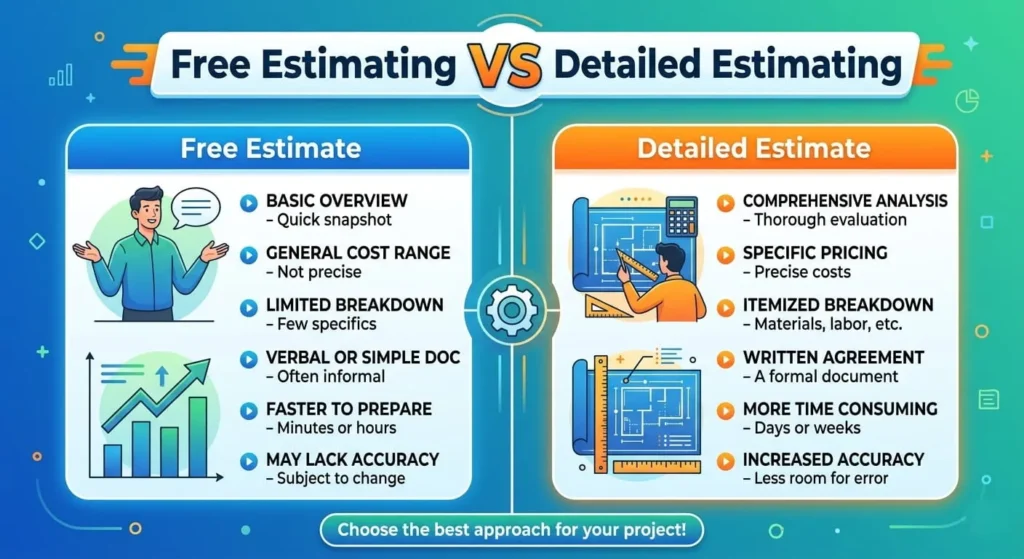
Free Estimate vs. Detailed Estimate?
Here’s exactly what you’re comparing when you put both documents next to each other:
| CATEGORY | FREE ESTIMATE | DETAILED ESTIMATE |
| Cost to You | Free (you pay later in change orders) | Paid fee ($500–$3,000+); credited toward contract |
| Format | Verbal or one-page summary | Multi-page itemized document |
| Labor Breakdown | Lump sum or vague range | Trade-by-trade line items |
| Materials | Generic allowances or excluded | Specified by brand, grade, and unit cost |
| NYC Permits / DOB | Rarely mentioned | Itemized with expected filing fees |
| COI Verification | Not addressed | Documented and attached |
| Contingency Line | None | 5–15% depending on complexity |
| Scope of Work Doc | Absent or boilerplate | Custom and legally defensible |
| Change Order Risk | Very High | Significantly Reduced |
| Best Used For | Initial vendor screening | Budget finalization, board approval |
What a Professional Scope of Work?
The scope of work is the backbone of any legitimate construction contract in New York City. If a contractor hasn’t produced a scope of work — a written, line-item description of every task, trade, and deliverable on your project — they are not ready to build for you. Here’s what it should include:

1. Demolition and Abatement
- Defined demo scope (what is being removed, how, and who hauls it)
- Asbestos and lead paint testing requirements (required in NYC pre-1978 buildings under Local Law 1)
- Dumpster or containerized debris removal — with NYC DSNY disposal compliance noted
2. NYC DOB Permits and Filing Costs
- Identification of whether project requires Alt-1, Alt-2, or Plumbing/Electrical permits
- Name of the licensed professional (PE or RA) filing on behalf of the owner if required
- Itemized DOB fee schedule based on current fiscal year rates
- Note on NYC buildings with Landmark status (LPC review adds 3–8 weeks and cost)
3. MEP Estimating
- Sub-bids from licensed subcontractors, not allowances
- Electrical load calculations if new circuits or panel upgrade involved
- Plumbing rough-in scope with confirmation of riser access and building sign-off protocol
- HVAC: existing system integration or new equipment specs with brand and model noted
4. Structural and Carpentry
- Framing scope with stud size and spacing spec’d
- Any structural alterations requiring engineer sign-off (beam pockets, load-bearing wall removal)
- Blocking locations for future grab bars, cabinetry, or TV mounts
5. Finishes
- Specified by manufacturer, product line, and unit cost — not allowances
- Paint: brand, sheen, number of coats, surface prep method
- Flooring: material, pattern, subfloor prep, transition details
- Tile: SKU or equivalent, grout spec, waterproofing membrane specified
6. Certificate of Insurance (COI) Requirements
This is a New York City-specific item that gets ignored in free estimates constantly. If you live in a luxury co-op on the Upper West Side, a glass tower in Hudson Yards, or a managed condo in DUMBO, your building will require the contractor to name your building or management company as an additional insured on their COI before they can bring materials through the service entrance.
COI requirements vary by building:
- General Liability minimums: typically $1M per occurrence / $2M aggregate (some luxury buildings require $2M/$4M)
- Workers’ Compensation: mandatory in New York State for any contractor with employees
- A detailed estimate from a legitimate contractor will list COI compliance as a line item and attach a sample COI from their broker.
7. Contingency
No honest contractor working in New York City will guarantee zero surprises. NYC housing stock — especially pre-war buildings in the Bronx, brownstone Brooklyn, or Crown Heights — hides decades of unlicensed work, asbestos-wrapped pipes, out-of-level floors, and electrical panels that haven’t seen an inspector since the Carter administration. Contingency line items should range from:
- 5% of total contract for new construction or gut renovations in newer buildings
- 10–15% for pre-war buildings, co-ops with shared risers, or projects in occupied spaces
- Any contractor who does not include contingency is telling you what you want to hear.

Red Flags in Free Estimates? Needs to Watch
After two decades on the tools and in the office in this city, these are the red flags that should make you pause before you sign anything:
- The estimate arrived in less than 24 hours after a site visit. A legitimate takeoff for a renovation of any meaningful scope takes time.
- No DOB permit line item. If the contractor isn’t mentioning permits, either they’re not planning to pull them — which is your liability, not theirs — or they haven’t thought about it.
- Material “allowances” throughout. An allowance is a contractor’s way of saying “I don’t know yet, and I’m going to charge you for it later.”
- No subcontractor names or license numbers. In NYC, licensed plumbers and electricians must be named on DOB filings. A GC who can’t tell you who’s doing the trade work hasn’t hired them yet.
- The estimate is 30–40% below competing bids. This is the classic low-ball. The number is designed to win the contract. The change orders are where the real pricing lives.
- No mention of building management coordination or board approval process for co-ops/condos. Anyone who’s worked in NYC residential for more than six months knows the alteration agreement process.
- Verbal estimates only, nothing in writing. Walk away.
How Low-Ball Estimates Really Work?
Here’s how this plays out in practice. You receive three estimates for your kitchen renovation in Park Slope:
- Contractor A: $68,000 (free estimate)
- Contractor B: $71,500 (free estimate)
- Contractor C: $74,000 (detailed estimate, $1,000 pre-construction fee credited back)
You hire Contractor A because they came in lowest. Demo starts. Then the calls begin.
- First Week: We found mold behind the tile. That’s not in scope. Change order: $3,200.
- 2n Week: The electrical panel needs to be upgraded to run the new range. Change order: $4,800.
- 3rd Week: The cabinets you chose came in over your $5,000 allowance. Overage: $6,400.
- 4th Week: Plumber says the supply lines need full replacement. Change order: $5,500.
You’re now at $87,900 and the project isn’t done. Contractor C, who did the actual work upfront, would have identified most of these conditions during their pre-construction site analysis. Their “higher” bid was the real number.
In New York City, change orders are legally binding contract amendments. Once you sign one, you’re on the hook. And in a city where project timelines run long and leverage shifts quickly to the contractor once walls are open, you are not in a strong negotiating position.
When the Free Estimate Is Really Useful?
Free estimates aren’t worthless — they’re just misused. Here’s when they serve a legitimate purpose:
- Initial vendor screening: Use free estimates to identify which contractors are in your budget range before investing in a paid pre-construction consultation.
- Simple, defined-scope work: Painting a two-bedroom apartment. Replacing a water heater. Refinishing existing hardwood floors. These projects have limited variables. A free estimate from a licensed contractor with verifiable references is probably fine.
- Getting to three bids: Before spending money on a detailed estimate, use free estimates to shortlist two or three contractors who seem professional, responsive, and appropriately licensed.
The mistake homeowners make is treating a free estimate for a complex renovation the same way they’d treat one for a paint job. They are not the same document. They should not be used the same way.
Most Asked Question and Answer About Free vs Detailed Estimating In NYC?
Is it normal to pay for an estimate in New York City?
For simple projects, no. For anything involving permits, structural work, or full-room renovations in a managed building, yes — and increasingly so. As skilled contractor time becomes more scarce in the tri-state market, legitimate firms are less willing to invest 4–8 hours of senior estimator time for free. The pre-construction fee reflects real labor. Treat it accordingly.
My co-op board requires three estimates before approving my alteration agreement. Does that mean three detailed estimates?
Not necessarily, but the estimate you submit to your board should be far more detailed than a one-page summary. At minimum, it should include a scope of work, a permit plan, and proof that the contractor carries the COI minimums your building requires. Many co-op boards in Manhattan and Brooklyn are becoming more sophisticated about this — they’ve seen too many renovation projects go sideways and get abandoned mid-gut.
A contractor told me they don’t pull permits because it ‘slows the project down.’ Should I be concerned?
You should be more than concerned. Unpermitted work in NYC creates title issues when you sell, voids your homeowner’s insurance for related claims, and — if discovered by DOB — can result in a Stop Work Order, mandatory removal of completed work at your expense, and civil penalties. The contractor who suggested this is asking you to absorb their liability. The answer is no.
How do I know if a contractor’s detailed estimate is actually detailed enough?
Ask for the following in writing: a line-item scope of work, the license numbers of any subcontractors they plan to use, a copy of their current COI naming your building as additional insured, a list of what permits will be pulled and who will be the filing professional, and a clear contingency line item. If they can’t or won’t produce all of these, the estimate isn’t detailed — it’s just longer.
I’ve already signed a contract based on a free estimate and work has started. What do I do when the change orders come?
First, don’t sign any change order without a written justification referencing the specific condition that triggered it and the line in the original scope of work that excluded it. Second, if you believe a change order is inflated or manufactured, you have the right to get a second opinion price from another licensed contractor before signing. Third, for disputes on projects over $25,000, consider engaging a construction attorney who specializes in NYC residential contracting. The New York State Contractor Licensing law and NYC’s Home Improvement Contractor (HIC) regulations do provide owner protections — but only if you understand them and invoke them in writing.

Final Thoughts
If you’re managing property in New York City — whether it’s a brownstone in Bed-Stuy, a co-op in the East 70s, or a retail space in Astoria — you are operating in a market that rewards preparation and punishes shortcuts. A free estimate is not a budget. It is the beginning of a sales process.
A detailed estimate, produced by a contractor who’s done the actual work of understanding your project, is an investment in accuracy. It costs money. It saves more.
Ask every contractor you’re considering three questions before you agree to anything:
- What is included in your estimate, and what is explicitly excluded?
- Will you pull the permits, and will you put that in writing?
- Can I see your current COI and your NYC Home Improvement Contractor license?
The contractors who answer all three without hesitation are the ones worth having a longer conversation with. The ones who deflect, hedge, or pressure you to sign before you’re ready? You already know what to do.