There’s a particular kind of anxiety that strikes when you’ve found your lot, sketched your dream on a napkin, and suddenly need to know: how much will this actually cost? Before any architect has drawn a line and before any builder has handed you a formal bid, you’re left estimating something enormous — your future home — with imperfect information and, usually, real money on the line.
In New York, this challenge is amplified tenfold. Land is scarce, labor is among the most expensive in the country, and the regulatory environment adds layers of cost that simply don’t exist in most other markets. We spoke with dozens of first-time builders and industry professionals across the five boroughs and surrounding suburbs to document how people actually navigated those early estimates — and what they wish they’d known.
The Four Approaches People Actually Use
When we asked first-time builders how they came up with their early numbers, virtually every approach fell into one of four categories. Most people used a combination of at least two. Here’s what each looks like in practice — and how reliable each proved to be.
1. Studying Recent Comparable Builds
The instinct to look at what others have built nearby is a sound one. New homes that closed recently, especially those with public tax filings or listing histories in NYC, can give you a rough anchor for what the market is actually delivering. Online real estate databases, DOB (Department of Buildings) permit filings, and even walking through open houses in new developments all yield data.
The limitation, however, is significant: you’re seeing the finished product’s sale price, not the construction cost. In NYC, land values, carrying costs, and developer margins can represent 40–60% of a new home’s price. Subtract those and your “comparable” number dissolves into a much smaller figure than you hoped.
Using a Cost-Per-Square-Foot Benchmark
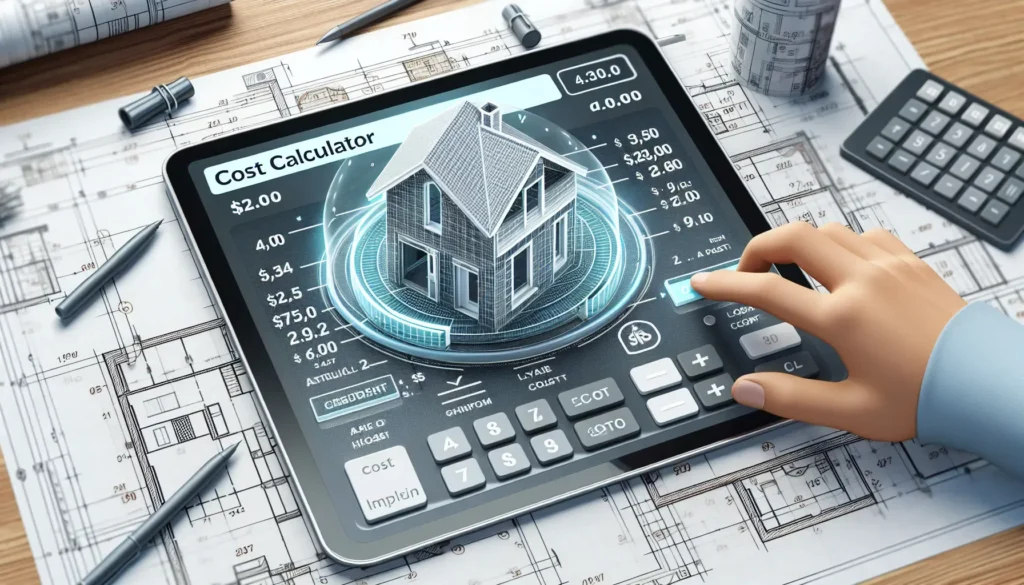
The $/sq ft heuristic is the industry’s most widely used starting point — and also its most widely abused. For a rough sanity check, it’s invaluable. For anything approaching real financial planning, it needs several important qualifications.
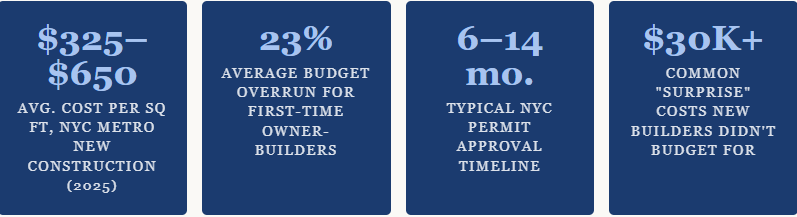
In the NYC metropolitan area, construction costs for a quality custom home typically range from $325 to $650 per square foot for the structure alone, depending on finishes, structural complexity, and borough or county. Add soft costs — architecture, engineering, permits, and financing — and you’re typically adding another 20–30% on top.
| Location | Build Type | Est. $/sq ft (Structure) |
|---|---|---|
| Manhattan / Brooklyn | Custom luxury | $500 – $650+ |
| Queens / Bronx / Staten Island | Custom mid-range | $375 – $500 |
| Westchester / Long Island | Custom mid-range | $325 – $450 |
| Northern NJ / CT suburbs | Custom mid-range | $280 – $395 |
| Hudson Valley / Catskills | Modest custom | $225 – $340 |
The most common mistake is applying a single statewide number to a project with exceptional site conditions — a sloped lot, poor soil bearing capacity, or a tight urban infill site where every delivery truck is an event. In those cases, the base $/sq ft figure can be 20–40% higher before you’ve chosen a single finish.
Talking to Multiple Contractors Early
Some of the most financially prepared first-time builders we spoke with made a habit of informal conversations with general contractors well before they had formal plans. These weren’t bids — they were discovery conversations. A good contractor, especially one who has built in the specific municipality you’re targeting, can give you directional feedback on local labor rates, known permitting delays, and site-specific cost drivers in 30 minutes over coffee.
The key is approaching these conversations with humility and honesty about where you are in the process. Contractors are skilled at reading first-time builders, and those who are transparent about their budget uncertainty tend to get more candid feedback than those who project false certainty.
Waiting for Formal Plans and Pricing
Some first-time builders deliberately chose not to estimate at all until they had formal architectural drawings and could solicit actual bids. On paper, this seems like the most rigorous approach. In practice, it often created a different problem: families had made significant emotional and financial commitments to a project before discovering the true cost — paid for land, engaged an architect, and sometimes pulled their children from schools — only to receive bids they couldn’t afford.
If you’re going to wait for formal pricing, at minimum do a basic sanity check: take the rough square footage you’re planning and multiply by the low end of local $/sq ft estimates. If that number would already strain your financing capacity, you need to know that before the architecture fees accumulate.
The Costs First-Time Builders Most Commonly Miss
Across our interviews, certain budget surprises appeared repeatedly — not because they’re obscure, but because they’re genuinely easy to overlook when you’re focused on the house itself.
- Soft costs and professional fees Architecture, structural engineering, expediting services, MEP engineering, surveys, and soil borings routinely add 12–18% to the hard construction cost in NYC. Many first-timers budget 6–8% and are caught short.
- NYC and municipal permitting costs Filing fees, plan examination fees, and required inspections are substantially higher in the five boroughs than elsewhere. A complex custom home in Brooklyn can generate $15,000–$30,000 in city fees alone, before any expediter costs.
- Carrying costs during construction If you’re paying rent while building, or servicing a construction loan that doesn’t convert to a mortgage until certificate of occupancy, 18 months of interest and rent can easily total $80,000–$150,000 in the NYC market. This is money spent on the project that never shows up in any contractor’s quote.
- Contingency — real contingency Industry standard for owner-builders is a 15–20% contingency on top of the total project cost. Most first-timers budget 5–10%. On a $1.2M project, that difference is $60,000–$120,000 that may not be there when you need it.
- Site work specific to NYC conditions Underpinning neighboring structures, managing groundwater, removing existing slabs or foundations, and navigating party wall agreements are all costs that emerge during construction and are extremely difficult to price before excavation begins.
- Temporary utilities and site infrastructure Temporary power, water, and sanitary facilities during construction, plus scaffolding and sidewalk sheds required by NYC law for structures adjacent to public sidewalks, add meaningful costs most online estimating tools ignore entirely.
What People Would Estimate Differently
We asked everyone the same final question: if you were starting the estimation process over, what would you do differently? The answers clustered around a few consistent themes.
The most common response was start with the total project budget, not the construction budget. Experienced builders think about an all-in number — land, carrying costs, design, construction, landscaping, and contingency — and then work backward to what they can afford to spend on the structure itself. First-timers tend to fall in love with a construction number and forget to add everything surrounding it.
Second was pay for a pre-design feasibility study. For $3,000–$8,000, an architect or experienced owner’s representative can give you a serious early cost model based on your specific program, site, and municipality before you commit to full design services. Many called this the best money they spent on the entire project.
Third, and perhaps most important for the NYC market specifically: get a local expediter involved early. An expediter who works daily with the DOB in your target borough is not just a permit service — they are an early warning system. They know which block is flagged for infrastructure upgrades, which community board is currently hostile to new construction, and which structural conditions under a specific zip code will trigger special inspections. That intelligence, obtained before you’ve committed to a site, can save you six figures.
A Practical Framework for Early Estimation
Based on what we heard, here is a practical sequence for arriving at a defensible early estimate before you’ve met a single builder:
- Establish your total project ceiling firstBefore estimating anything, define the maximum all-in number you can finance and remain financially stable. This is your ceiling. All subsequent estimates work inside it.
- Subtract non-construction costs from the ceilingDeduct land (already spent or priced), carrying costs for your timeline, design and engineering fees (budget 15% of construction), permitting, and a 15% contingency. What remains is your construction budget.
- Divide by realistic local $/sq ftDivide your construction budget by the appropriate rate for your location and finish level. The result is the maximum square footage you can realistically build. If that number is smaller than your program, you have a problem to solve before architecture starts.
- Validate with one informal contractor conversationBefore doing anything else, have one honest conversation with a GC who has built in your target municipality in the last two years. Show them your rough program and site. Ask if your budget is in the right universe. Adjust accordingly.
- Commission a feasibility study before full designIf the numbers still pencil, spend the money on a proper pre-design feasibility estimate before committing to full architectural services. It is the single most cost-effective step in the process.
Building in New York is genuinely different from building almost anywhere else. The regulatory environment, labor costs, and density-related site complications create a cost structure that routinely surprises even sophisticated first-time builders. The antidote isn’t pessimism — remarkable homes get built here every year within reasonable budgets. The antidote is an honest, comprehensive early estimate that accounts for everything surrounding the structure, not just the structure itself.
The builders who navigated the process most successfully weren’t necessarily the ones with the largest budgets. They were the ones who knew their real numbers before they fell in love with a plan.