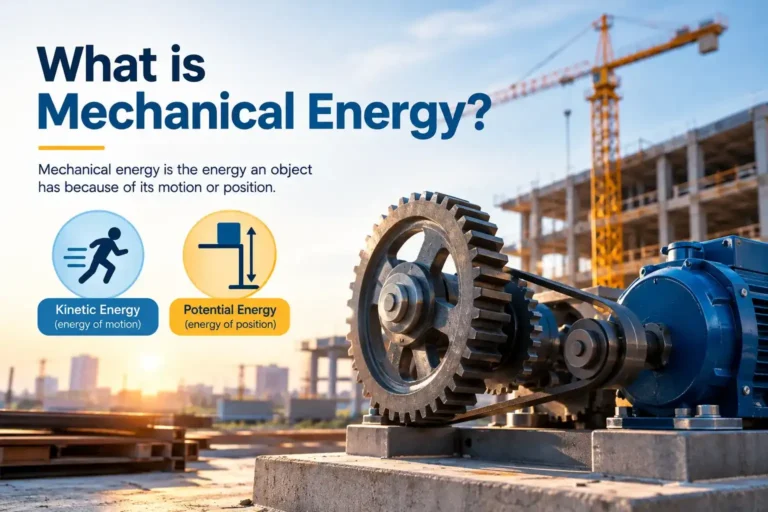
Mechanical energy is the total of an object’s kinetic energy (energy of motion) and potential energy (stored energy due to position or configuration). It is measured in joules (J) and written as:
E_mechanical = KE + PE
A moving car has mechanical energy because of its speed. A barbell held above a lifter’s head has mechanical energy because of its height. A spinning flywheel and a compressed spring both have it too.
Key takeaways
- Mechanical energy = kinetic energy + potential energy.
- The SI unit is the joule (1 J = 1 N·m = 1 kg·m²/s²).
- It stays constant only when no non-conservative forces, such as friction or air resistance, do work on the system.
- Where friction acts, mechanical energy is converted into thermal energy and sound. The total energy is still conserved, but the mechanical part is not.
The Two Components of Mechanical Energy
1. Kinetic energy (energy of motion)
Any object with mass that is moving has kinetic energy. For an object moving in a straight line:
KE = ½ m v²
(m = mass in kg, v = speed in m/s)
Because speed is squared, doubling an object’s speed quadruples its kinetic energy. This is why high-speed collisions are so much more destructive.
Kinetic energy comes in several forms:
- Translational: motion from one place to another (a cyclist riding down a road).
- Rotational: motion around an axis, KE = ½ I ω², where I is the moment of inertia and ω is angular speed (a spinning wheel or turbine).
- Vibrational: oscillating motion, such as atoms in a solid or a vibrating guitar string. In practice, vibration involves a continual exchange between kinetic and potential energy.
2. Potential energy (stored energy)
Potential energy is energy stored in a system because of the position of an object in a force field or because of its configuration. The two types most relevant to mechanical energy are:
- Gravitational potential energy: PE = m g h (g ≈ 9.81 m/s² near Earth’s surface, h = height above a chosen reference level)
- Elastic potential energy: PE = ½ k x² (k = spring constant, x = stretch or compression distance)
Potential energy is always measured relative to a reference point (the “zero level”) that you choose. Only changes in potential energy have physical meaning, so the choice of zero level is a matter of convenience.
Worked Examples
| Situation | Calculation | Result |
|---|---|---|
| A 1,000 kg car travelling at 20 m/s (72 km/h) | KE = ½ × 1000 × 20² | 200,000 J (200 kJ) |
| A 100 kg barbell held 2 m above the floor | PE = 100 × 9.81 × 2 | ≈ 1,962 J |
| A 500 kg roller-coaster car at the top of a 30 m hill (at rest) | PE = 500 × 9.81 × 30 | ≈ 147,150 J |
Roller coaster, step by step: At the top of the hill the car has mostly potential energy. As it descends, potential energy converts to kinetic energy and speed increases. At the bottom, nearly all of that energy is kinetic. If friction and air drag were zero, the total would stay the same throughout the ride. In reality some mechanical energy is lost as heat, which is why the next hill must be lower than the first.
Conservation of Mechanical Energy
When only conservative forces (such as gravity and ideal spring forces) act on a system, total mechanical energy remains constant:
KE₁ + PE₁ = KE₂ + PE₂
A frictionless pendulum is the classic case. At the highest point of its swing it has maximum potential energy and zero kinetic energy. At the lowest point it has maximum kinetic energy and minimum potential energy. The sum stays the same.
When non-conservative forces such as friction or air resistance act, mechanical energy decreases. It is converted to thermal energy, not destroyed, so the total energy of the universe is still conserved.
Everyday Examples of Mechanical Energy
- A thrown baseball: kinetic energy during flight, plus gravitational potential energy that changes with height.
- A brick on a ledge: potential energy from its height, converting to kinetic energy as it falls.
- A wind turbine: moving air has kinetic energy that turns the blades, and the rotation drives a generator.
- A drawn bow: elastic potential energy in the flexed limbs converts to the arrow’s kinetic energy on release.
- A hydroelectric dam: water stored at height has gravitational potential energy, which becomes kinetic energy as it flows through turbines.
Mechanical Energy vs. Other Forms of Energy
| Feature | Mechanical energy | Thermal energy | Chemical energy |
|---|---|---|---|
| Source | Motion and position of objects | Random motion of particles | Bonds between atoms |
| Example | Moving car, raised weight | Hot water | Fuel, food, batteries |
| Can convert to mechanical? | n/a | Yes (heat engines) | Yes (muscles, engines) |
A Brief History
The concept of energy in mechanics developed through the 18th and 19th centuries. The term “kinetic energy” is credited to Lord Kelvin (William Thomson) in the mid-1800s, and “potential energy” was introduced by the Scottish engineer William Rankine around 1853. The joule is named after James Prescott Joule, whose experiments showed that mechanical work and heat are equivalent.
Frequently Asked Questions
What is mechanical energy in simple words?
It is the energy an object has because it is moving or because of where it is (or how it is arranged), such as its height or a compressed spring.
What is the formula for mechanical energy?
E = KE + PE, where KE = ½mv² and gravitational PE = mgh.
Can mechanical energy be negative?
Potential energy can be negative if the reference level is set above the object. Kinetic energy cannot be negative. The total can be negative depending on the chosen reference.
Is mechanical energy always conserved?
No. It is conserved only when no non-conservative forces like friction do work. Otherwise it converts to other forms such as heat.
Does a stationary object have mechanical energy?
Yes, if it has potential energy, such as a book on a shelf. It has zero kinetic energy but non-zero potential energy relative to the floor.
What is the unit of mechanical energy?
The joule (J).