Hiring the wrong estimator doesn’t just cost money — it costs you bids. Here’s how to make the right call before your next project hits your desk.
Picture this: you’ve got three bids due Friday, your estimator just called in sick, and the phone keeps ringing with new project inquiries. Sound familiar? If you run a construction firm — large or small — the question of who estimates your work is one of the most operationally critical decisions you’ll make.
And yet, most contractors default to one model without really examining whether it’s the right fit. Some assume a full-time, salaried estimator is the professional choice. Others assume freelancers are only for smaller outfits. The truth is more nuanced — and getting it wrong in either direction can quietly bleed your margins.
The Real Cost of Getting Estimates Wrong
Before comparing the two hiring models, it’s worth acknowledging what’s at stake. Estimating isn’t a back-office formality — it’s the engine that determines which jobs you win, at what margin, and whether those margins hold up through execution. A poorly estimated bid either prices you out of the market or locks you into a loss.
Whether your estimator is on payroll or working project-to-project, their output directly affects your bottom line. The question isn’t just about employment status — it’s about who gives you the right output, at the right time, for the right cost.
$110k+ 8–24hT 3–5X
Avg. full-time estimator salary Typical freelance turnaround on estimates Full-time vs. Freelance
Full-Time Estimators | The In-House Advantage
Who they are
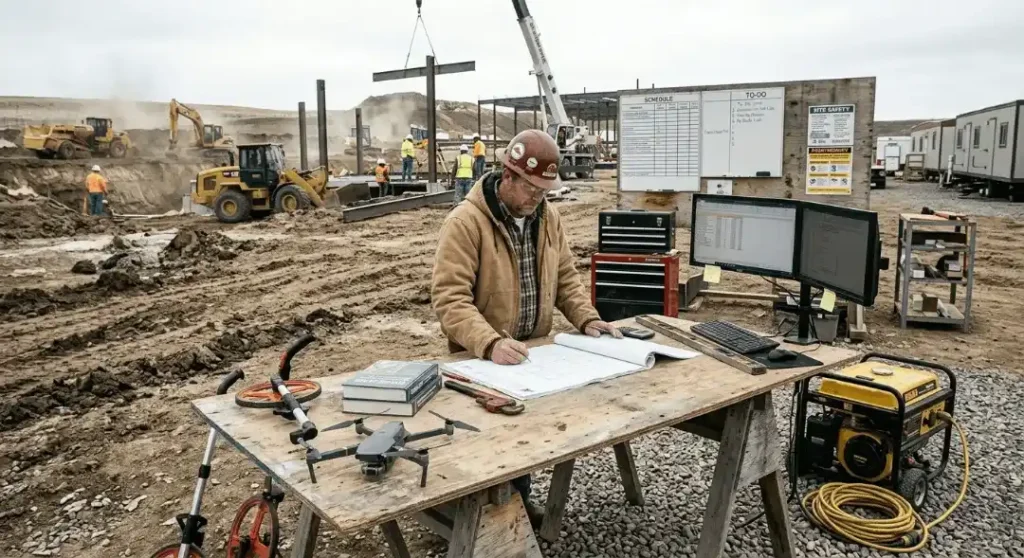
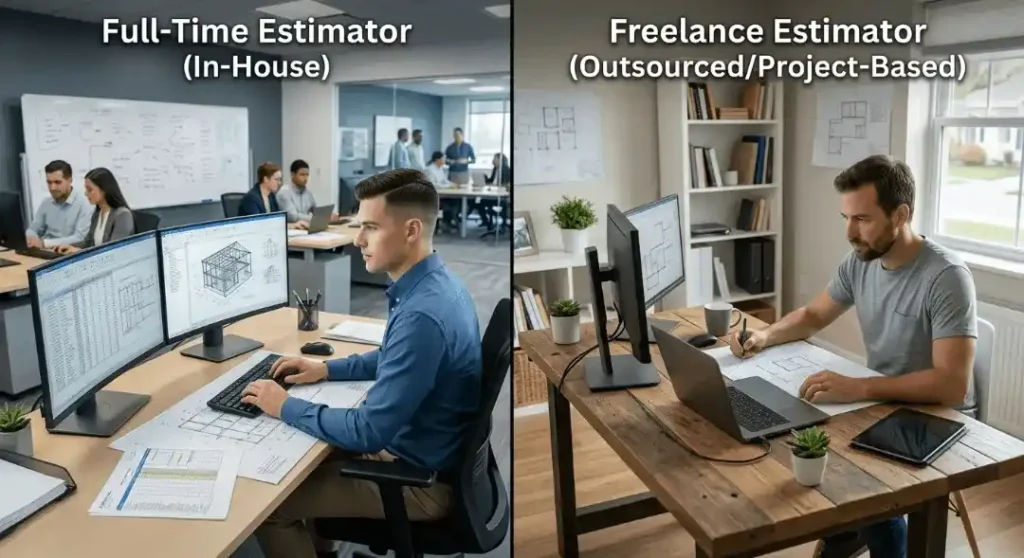
A full-time construction estimator is a permanent, salaried employee embedded in your organization. They show up every day, attend pre-bid meetings, build relationships with subcontractors, and develop a deep understanding of how your company prices and delivers work. Over time, that institutional knowledge becomes genuinely valuable.
They know your markup philosophy. They know which subcontractors you trust and which you don’t. They know your equipment costs without having to ask. That context is hard to replicate with someone who parachutes in for a single bid.
A great in-house estimator isn’t just pricing jobs — they’re encoding your company’s competitive intelligence into every number they put on paper.
The real overhead picture
Here’s where a lot of contractors get surprised. A full-time estimator’s sticker price is the salary — often ranging from $110,000 to $145,000 or more depending on experience and market. But the true cost goes well beyond that. Add health insurance, paid leave, retirement contributions, payroll taxes, software licenses (estimating platforms like Bluebeam, Sage, or PlanSwift aren’t free), a workstation, ongoing training, and the square footage of desk space they occupy — and the total annual cost can reach 1.4 to 1.6 times the base salary.
That’s not an argument against hiring one. It’s just the honest math you need to work with when evaluating the model.
Where full-time estimators shine — and where they struggle
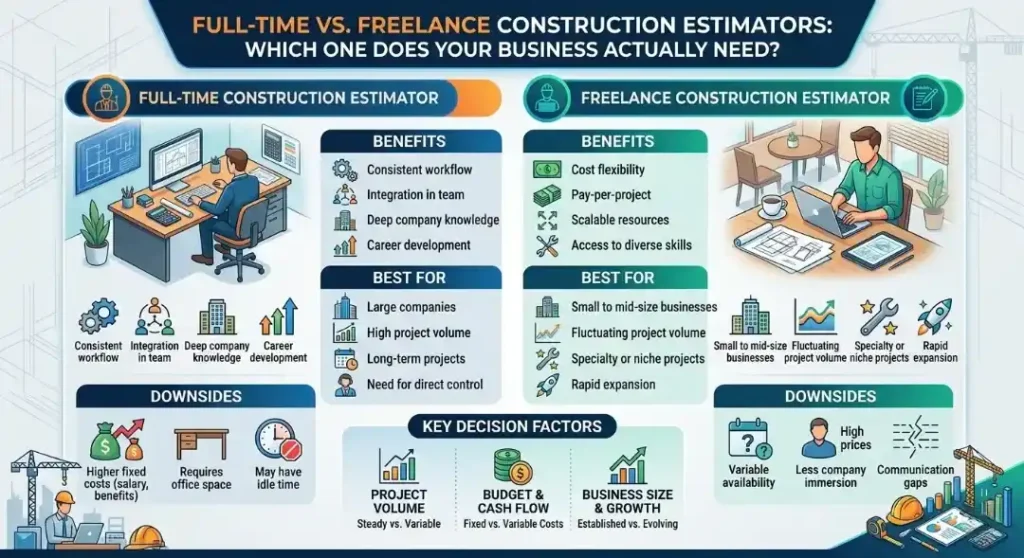
Full-time estimators work best for firms with a predictable, year-round volume of bid work. If your team is consistently preparing 10–20+ proposals per month across similar project types, a dedicated in-house estimator can handle that load efficiently and build the kind of institutional depth that pays dividends over years.
The challenge arises at the edges. During slow periods — weather-related downturns, seasonal lulls, economic cooling — a full-time estimator’s capacity goes underutilized while the fixed cost remains. And during peak bid seasons or sudden surges in RFP volume, a single person can become a bottleneck, forcing your team to miss deadlines or submit rushed numbers.
Freelance Estimators | The Flexible Alternative
Who they are
Freelance construction estimators are independent contractors who typically work with multiple clients simultaneously. They are hired on a project-by-project or retainer basis, billing either hourly or per estimate. Most have backgrounds working in-house at construction firms before transitioning to independent consulting, which means they often bring a breadth of experience that a single-company estimator can’t match.
Because they work across different contractors, trades, and project types, experienced freelance estimators tend to be comfortable with a wide range of estimating software and scope categories — MEP, civil, residential, commercial, industrial, and more. That cross-pollination of experience can be a genuine asset when you need specialized expertise on a project outside your firm’s usual lane.
The cost structure
Freelance estimating is typically billed per estimate (flat fee based on project complexity), hourly, or occasionally on a monthly retainer. You pay for the output, not the downtime. There are no benefits, no software licenses, no office overhead, and no payroll tax burden. For smaller and mid-sized contractors, this model can represent substantial savings — particularly when bid volume is inconsistent or seasonal.
The trade-off is per-unit cost. A single complex estimate from a freelancer may cost more than what a salaried employee would spend on the same task if amortized across the year. The economics favor freelancers when volume is lower or variable; they favor in-house staff when volume is consistently high.
Speed and turnaround
One underappreciated advantage of working with experienced freelance estimators is turnaround speed. Many offer estimates within 8 to 24 hours for standard scopes — a meaningful edge when a bid deadline appears suddenly or when an in-house estimator is already stretched thin. Construction bid cycles are rarely forgiving, and having a reliable freelancer you can call on short notice can be the difference between submitting and sitting out.
“Freelancers aren’t a fallback — for many growing firms, they’re the most efficient way to scale bidding capacity without scaling headcount.”
Side-by-Side | The Key Differences
| Category | Full-Time Estimator | Freelance Estimator |
|---|---|---|
| Employment Type | Permanent employee | Independent contractor |
| Cost Structure | Fixed salary + benefits | Per project or hourly |
| Overhead | High — desk, software, training | Low — no added company cost |
| Availability | Office hours, can bottleneck | Often 8–24h turnaround |
| Scalability | Fixed capacity | Highly flexible |
| Knowledge Depth | Deep, company-specific | Broad, cross-trade experience |
| Best For | Consistent, high-volume bidding | Variable or surge bid volume |
The Middle Ground
The most common framing of this question treats it as binary — you either hire full-time or you go freelance. But a growing number of mid-sized construction firms are using a hybrid model, and it’s worth considering seriously.
In a hybrid setup, a firm employs one in-house estimator who handles core, ongoing bid work and maintains company knowledge. When bid volume surges, or when a project falls outside the in-house estimator’s specialty (say, a large mechanical scope when your estimator is primarily civil), a trusted freelancer steps in. This gives you depth without paying double overhead.
It also provides a natural solution to the specialization problem. No single estimator is expert in every trade. A civil-focused estimator on staff supplemented by freelance MEP specialists when needed can outperform a generalist working alone.
The Onboarding Factor — Often Overlooked
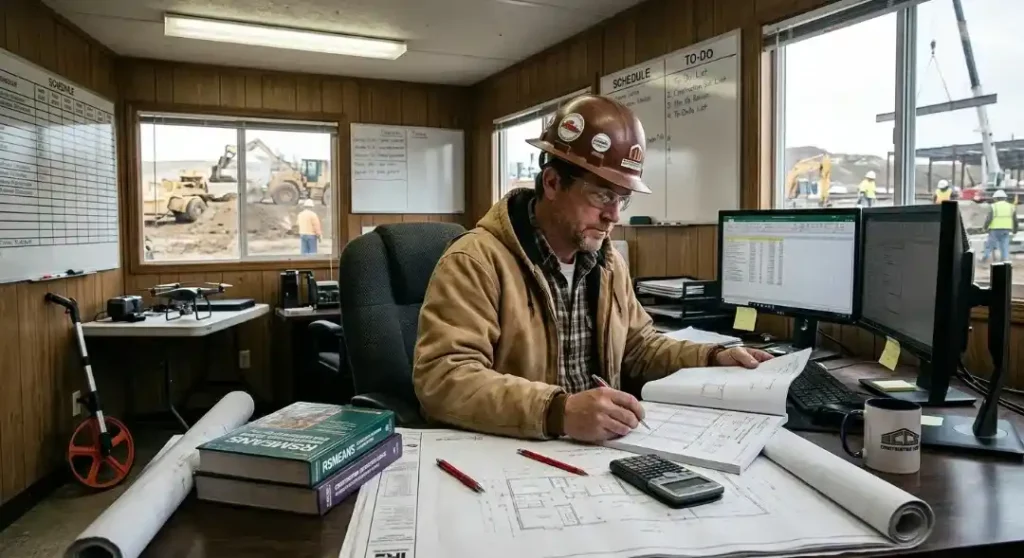
One cost that rarely appears in hiring calculators is onboarding time. A new full-time estimator doesn’t hit full productivity on day one. Learning your systems, your subcontractor relationships, your typical scope structures, and your margin targets can take three to six months — sometimes longer for complex commercial or industrial work. During that ramp-up, you’re paying full salary for partial output.
Experienced freelancers, by contrast, are typically ready to work with minimal handholding. They’ve seen the software, they know the document types, and they’re accustomed to adapting quickly to new clients’ formats. For firms that need capacity fast, this time-to-productivity gap matters.
So, Which One Should You Hire?
Choose full-time if…
- You have steady, year-round bid volume
- Your budget supports salary + overhead
- You need someone immediately available, daily
- Company-specific knowledge is a priority
- You’re a large firm with complex, ongoing bids
Choose freelance if…
- You’re small-to-mid-size with variable bid flow
- You’re experiencing a temporary surge in proposals
- You need specialized trade expertise (e.g. HVAC, electrical)
- You’re missing deadlines with your current setup
- You want to scale capacity without adding headcount
Final Thought
One thing worth remembering: your needs will change. A firm that’s best served by a freelancer today — because volume is inconsistent or margins don’t yet support the overhead — may be ready for a full-time hire in two years. And a firm with a full-time estimator should still maintain a shortlist of trusted freelancers for surge periods and specialized scopes.
The best construction companies treat estimating capacity the same way they treat equipment: you own what you use constantly, you rent what you need occasionally, and you never let a capacity gap cost you a contract you were otherwise qualified to win.