If you’ve ever wondered who calculates the cost of a skyscraper before the first brick is laid, the answer is a building estimator. They’re the financial architects of the construction world — the professionals who determine whether a project is viable, affordable, and worth bidding on, before a single shovel hits the ground.
This guide covers everything you need to know about what a building estimator does, their daily responsibilities, required skills, salary expectations backed by real government data, and what the future of this career looks like.

What Is a Building Estimator?
A building estimator (also called a construction cost estimator) is a professional who calculates the total cost of construction projects — including labor, materials, equipment, overhead, and time. They analyze blueprints, specifications, and project documents to produce detailed cost breakdowns that help construction firms submit competitive bids and plan their resources effectively.
According to the U.S. Bureau of Labor Statistics (BLS), construction cost estimators “prepare estimates for building, road, and other construction projects” and may calculate the total cost of an entire structure or individual components of a build.
Far from being just number-crunchers, building estimators are deeply involved in the front-end strategy of every project — helping companies win work while protecting their profit margins.
What Does a Building Estimator Do? Core Responsibilities
1. Reading and Analyzing Blueprints and Plans
The first and most foundational responsibility is interpreting construction documents. Estimators study architectural drawings, engineering specifications, and tender documents to fully understand the scope of work before calculating any costs.
2. Preparing Detailed Cost Estimates
This is the heart of the role. Estimators calculate costs across several categories:
- Labor — wages and hours needed per trade
- Materials — quantities and unit costs of every physical component
- Equipment — machinery rental or purchase costs
- Subcontractor services — costs for specialized trades like electrical, plumbing, or HVAC
- Overhead and contingencies — indirect costs and risk buffers
3. Performing Quantity Takeoffs
Estimators measure and quantify every element in a set of plans — how many cubic yards of concrete, how many linear feet of framing, how many fixtures — then price each item based on current market rates. Increasingly, this process is done digitally using takeoff software.
4. Analyzing Market Conditions
Good estimates don’t exist in a vacuum. Estimators track current and predicted material prices, labor availability, and regional cost variations to ensure their figures reflect real-world conditions at bid time.
5. Collaborating With the Project Team
Building estimators work closely with project managers, architects, engineers, procurement teams, vendors, and subcontractors. They align on scope, discuss value engineering opportunities, and resolve discrepancies between plans and field conditions.
6. Managing the Bid Process
Estimators are central to competitive bidding. They compile all cost data into a formal proposal, help decide the final bid price, and ensure the numbers are accurate enough to win the job without sacrificing the company’s profit margin.
7. Conducting Site Visits
To fully understand a project’s conditions — soil type, access restrictions, existing utilities, site hazards — estimators often visit the construction site in person. These visits inform assumptions built into the estimate.
8. Risk Analysis and Value Engineering
A skilled estimator identifies potential financial risks early — cost overruns, supply chain issues, weather-related delays — and factors those risks into the estimate through contingency planning or value engineering alternatives.
9. Producing Reports and Presentations
Estimators compile their findings into structured reports and presentations for company leadership, clients, or project owners, clearly communicating cost assumptions and project feasibility.
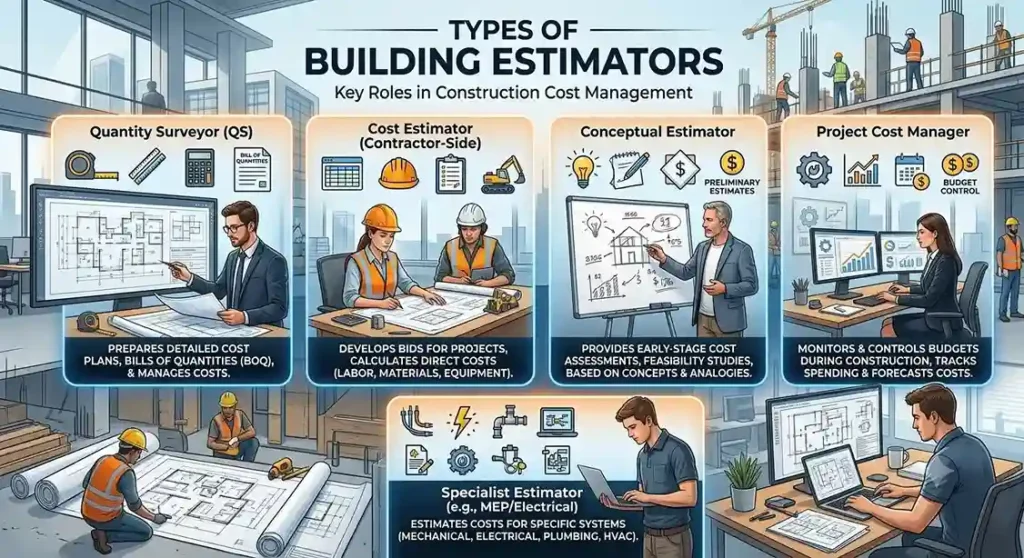
Types of Building Estimators
| Type | Focus Area |
|---|---|
| Residential Estimator | Single-family homes, townhouses, small developments |
| Commercial Estimator | Offices, retail spaces, hotels, shopping centers |
| Civil/Infrastructure Estimator | Roads, bridges, utilities, public works |
| Mechanical/Electrical/Plumbing (MEP) Estimator | Specialist systems within buildings |
| General Contractor Estimator | Full project scope across all trades |
| Specialty Subcontractor Estimator | Focused on a specific trade or material |
Key Skills a Building Estimator Needs
Technical (Hard) Skills
- Blueprint reading — understanding architectural and engineering drawings
- Mathematics and quantitative analysis — calculating quantities, costs, and variances with precision
- Software proficiency — tools like Bluebeam, Procore, Autodesk Build, PlanSwift, Sage Estimating, and Excel are industry standard
- Building Information Modeling (BIM) — increasingly expected as the industry digitizes
- Knowledge of construction methods and materials — understanding how buildings are actually built
Professional (Soft) Skills
- Attention to detail — a small error in a large estimate can cost a company millions
- Analytical thinking — weighing multiple cost variables and project risks simultaneously
- Communication and negotiation — liaising with vendors, subs, engineers, and clients
- Time management — delivering accurate estimates to tight bid deadlines
- Adaptability — staying current with AI, automation, and new estimating technologies
Education and Qualifications
Most employers prefer candidates with a bachelor’s degree in construction management, construction engineering, civil engineering, or a related field. However, associate degrees paired with substantial field or trade experience are also viable entry points — particularly at smaller firms.
Professional certifications that boost credibility include:
- CPE — Certified Professional Estimator (American Society of Professional Estimators)
- CCP/CEP — Certified Cost Professional / Cost Estimating Professional (AACE International)
- CCEA/PCEA — Certified Cost Estimator/Analyst (ICEAA)
- Procore Certified Professional — increasingly sought after for technology proficiency
Building Estimator Salary: Real Data
According to the U.S. Bureau of Labor Statistics, the median annual wage for cost estimators was $77,070 in May 2024, significantly above the national median of $49,500 for all workers.
Here’s a breakdown of salary ranges by experience level:
| Experience Level | Typical Annual Salary (USD) |
|---|---|
| Entry-Level (0–3 years) | $52,000 – $67,000 |
| Mid-Level (3–7 years) | $74,000 – $85,000 |
| Senior / Lead Estimator | $85,000 – $120,000 |
| Chief Estimator / Director | $125,000 – $160,000+ |
Compensation also varies by sector — commercial construction estimators typically earn between $75,000 and $110,000, while residential estimators tend to earn $60,000 to $95,000 depending on project scale and location.
Job Outlook for Building Estimators
The BLS projects a 4% decline in cost estimator employment from 2024 to 2034, largely driven by automation and improvements in estimating software that increase individual productivity. However, this headline number tells only part of the story.
Despite the projected dip, the BLS still forecasts approximately 16,900 job openings per year over the decade — primarily to replace retiring professionals. The estimating workforce skews significantly older, and the industry is in the middle of a generational handoff, creating real opportunity for new entrants.
On the demand side, an Associated General Contractors survey found that 92% of construction firms report difficulty hiring workers, with preconstruction roles like estimating among the hardest to fill. A 2025 Dodge Construction Network study also found that 87% of contractors believe AI will meaningfully impact their business — meaning the estimators who master new technology will command a significant competitive advantage.
Building Estimator vs. Project Manager: What’s the Difference?
These roles are closely related but distinct. A building estimator works primarily at the pre-construction phase — before work begins — calculating what a project should cost and helping the firm win the bid. A project manager takes over once the job is awarded, overseeing the actual execution of the work to stay on time and within the estimated budget. Many senior estimators transition into project management or executive roles as their careers advance.
Is a Career as a Building Estimator Worth It?
For people who enjoy combining financial analysis with the physical world of construction, this career is highly rewarding. You sit at the intersection of business development and technical knowledge — the person whose accuracy directly determines whether a company wins profitable work or takes a loss. The pay is competitive, the path for advancement is clear (senior estimator → chief estimator → VP of preconstruction), and the demand for skilled professionals remains strong despite technological change.
The role is evolving from manual takeoffs and spreadsheets to AI-assisted estimation, digital BIM workflows, and real-time cost databases — meaning the estimators entering the profession today will be the ones shaping what the job looks like in the next decade.
Frequently Asked Questions
Do building estimators need to know how to read blueprints?
Yes. Blueprint reading is a non-negotiable foundational skill. Estimators must accurately interpret architectural, structural, mechanical, and electrical drawings to measure and quantify project scope.
What software do building estimators use?
The most widely used platforms include Procore, Bluebeam Revu, Autodesk Construction Cloud, PlanSwift, Sage Estimating, and Microsoft Excel. BIM tools like Revit are increasingly relevant.
Can you become a building estimator without a degree?
Yes. While a bachelor’s degree is preferred by most large firms, candidates with an associate degree and relevant trade or field experience can enter the profession — especially at smaller contractors. Certifications help compensate for the lack of a four-year degree.
How long does it take to become a building estimator?
With a relevant bachelor’s degree, most estimators become proficient within 2–3 years of on-the-job experience. Those entering from the trades may take longer to transition but bring valuable practical knowledge.